ES
 DE
 FR
 IT


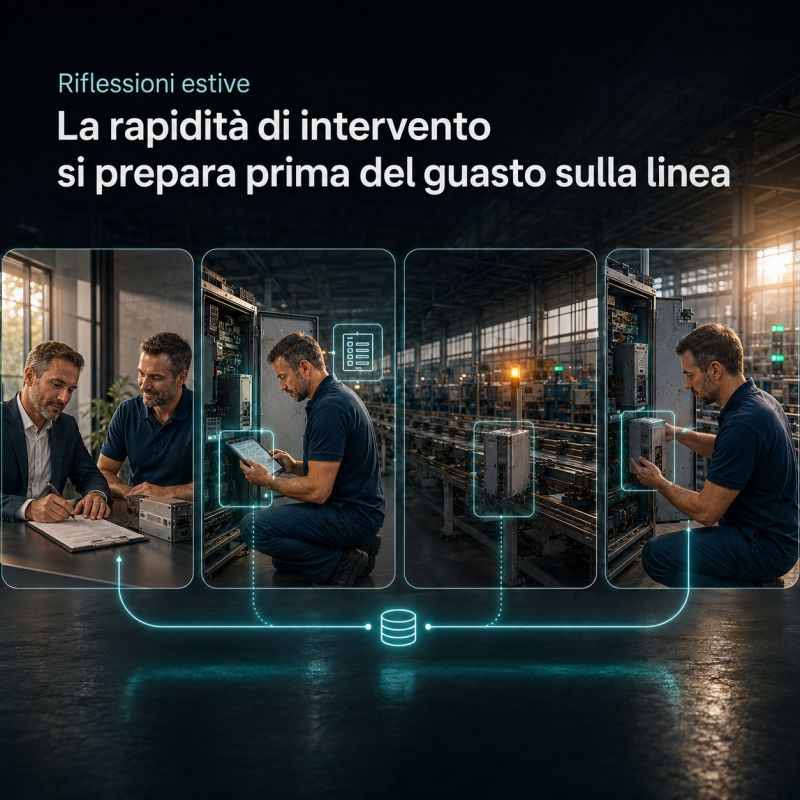
☀️ Summer reflections | Fast intervention is prepared before the line fails
When an electronic device fails and a production line stops, the question is almost always the same:
⏱️ How long will it take to restart?
At that moment every hour counts. Production is slowed down or completely stopped, priorities suddenly change and the whole organisation focuses on finding the fastest solution.
Yet how quickly downtime can be handled does not depend only on what happens after the failure.
💡 Very often it depends on how much was done beforehand.
🔍 Fast intervention starts with knowing the plant
When we receive a faulty device for the first time, we necessarily have to start by gathering basic information to understand, for example, what type of product it is, whether there are programs and parameters to recover, which machine it was installed on and what function it performs, as well as whether the product is still supported by the manufacturer.
Gathering information and organising the intervention are essential activities that take time.
However, if this information has been gathered in advance, you don’t start from scratch when the emergency hits.
This is one of the most important functions of a maintenance contract for industrial electronics, and in particular for devices that are entering or have already entered a phase of obsolescence.
⚙️ Knowing in advance what could stop production
Not all components installed on a line are equally critical.
The failure of some devices can be managed without significant consequences. Others, however, can cause the immediate shutdown of the entire machine or of a significant part of the production process.
That is why one of the first steps should be mapping the installed electronic base.
PLCs, HMIs, drives, inverters, power supplies, electronic boards, control systems, peripherals and other devices can be classified according to several factors:
- criticality for production;
- age of the device;
- obsolescence status;
- availability of spare parts;
- possibility of repair or remanufacturing;
- availability of any replacement units;
- availability of programs, firmware, parameters and configurations.
⚠️ This analysis can produce a genuine obsolescence risk map of the plant.
And this is exactly where a more informed maintenance strategy can begin.
💾 The backup can be worth as much as the component
When it comes to industrial electronics, the value of a device does not lie solely in the hardware.
A fundamental part often consists of the information it contains.
Programs, parameter sets, configurations and settings developed over the years can be essential to quickly bring a machine back to its pre-failure operating conditions.
That is why, where technically possible, a preventive maintenance strategy should also include checking the availability of backups of programs and parameters.
An immediately available replacement device may in fact not be enough if we don’t have what is needed to configure it correctly.
💡 Being prepared therefore means protecting not only the physical component, but also the digital assets needed for it to work.
🔧 Spare parts and remanufactured units: decide before the emergency
Another fundamental element is the availability of alternatives.
When a component is still normally available on the market, replacement can be relatively simple.
The situation changes with devices installed ten, fifteen or twenty years ago.
The product may no longer be sold by the manufacturer, spare parts may be hard to find and migrating to a new technology may require hardware, software and installation changes.
Waiting for the failure to tackle these problems means turning a technical issue into a production emergency.
Analysing them in advance, instead, makes it possible to evaluate different strategies:
🧩 repairing the existing device, remanufacturing, having a replacement unit available, building a strategic stock or planning a future technology migration.
There is no one-size-fits-all solution.
But it is possible to be prepared.
⏱️ From unpredictable failure to an organised process
A maintenance contract cannot prevent every failure.
But it can significantly reduce the uncertainty with which the failure is handled.
When there is an ongoing technical relationship, the customer already knows whom to contact and what information to provide.
At the same time, those who have to intervene can know the plant, the installed devices, the production critical points and the possible recovery strategies in advance.
So when the emergency arrives, an important part of the work has already been done.
The question is no longer just:
“What device is this?”
but can immediately become:
“What is the fastest and most effective solution to get this line running again?”
And that is a substantial difference.
♻️ Obsolescence makes prevention even more important
Preventive management becomes particularly strategic when the plant uses obsolete technologies.
Obsolete, in fact, does not necessarily mean unusable.
In many companies there are machines that have been running for decades and still deliver quality, productivity and reliability.
The problem arises when one of the key electronic components is no longer easy to find.
In these cases, maintenance should not be limited to handling the individual failure.
It should gradually become a form of Obsolescence Management, able to support the entire life cycle of the plant.
Knowing which components are most vulnerable makes it possible to decide where to focus resources, spare parts and preventive activities.
🛠️ Speed is built before downtime
When a line has already stopped, it is too late to start asking which components of the plant are critical, where the programs are stored or whether a compatible unit still exists.
The best time to answer these questions is while the machine is still producing.
This is the change of perspective we propose.
Maintenance should not be seen only as the ability to react quickly to a failure.
It should also be the ability to prepare today the response to tomorrow’s possible failure.
💡 Because production continuity cannot be improvised during an emergency: It is built over time, through knowledge, planning and collaboration.
And when downtime comes, being already prepared can make the difference between starting to look for a solution and having started to build it long before.
❓ A question for companies
Do you already know which electronic components on your line could stop production if they failed?
If the answer isn’t immediate, perhaps this is exactly the question an obsolescence maintenance strategy should start from.